Humming at speed? Diagnosing a bad wheel bearing or hub
A growl that rises with road speed is often a wheel bearing. How to confirm it, tell it from tire noise and choose the right hub assembly.
A low hum or growl that grows louder as you speed up is one of the most common noises we’re asked about. Most of the time, it’s a wheel bearing. Here’s how to confirm it before buying parts.
What a bad bearing sounds like
- A hum, growl or “airplane” drone that rises with vehicle speed, not engine speed
- Noise that changes when you turn: louder in a gentle curve one way, quieter the other way
- Sometimes a vibration in the steering wheel or floor
- In advanced cases, a grinding sound or play in the wheel
Because the noise follows road speed, shifting into neutral while coasting doesn’t change it. That’s a quick way to rule out engine and transmission noise.
Bearing or tires?
Tires with uneven wear, such as cupping or feathering, make a very similar hum. Before blaming the bearing:
- Look at the tire treads and run a hand over them. Scalloped, uneven wear points to tires or worn shocks.
- Rotate the tires. If the noise moves to a different corner, it’s the tire.
Pinpointing the corner
- Swerve test: on a safe, empty road, gently weave left and right at 40–50 mph. A bearing gets louder when it’s loaded. Turning left loads the right-side bearings, and turning right loads the left side.
- Lift test: raise the corner safely, grab the tire at 12 and 6 o’clock and rock it. Any clunk or play suggests a bearing (or ball joint). Spin the wheel by hand and feel for roughness.
- Stethoscope or chassis ears: a technician can listen to each hub on a lift.
Hub assembly or pressed bearing?
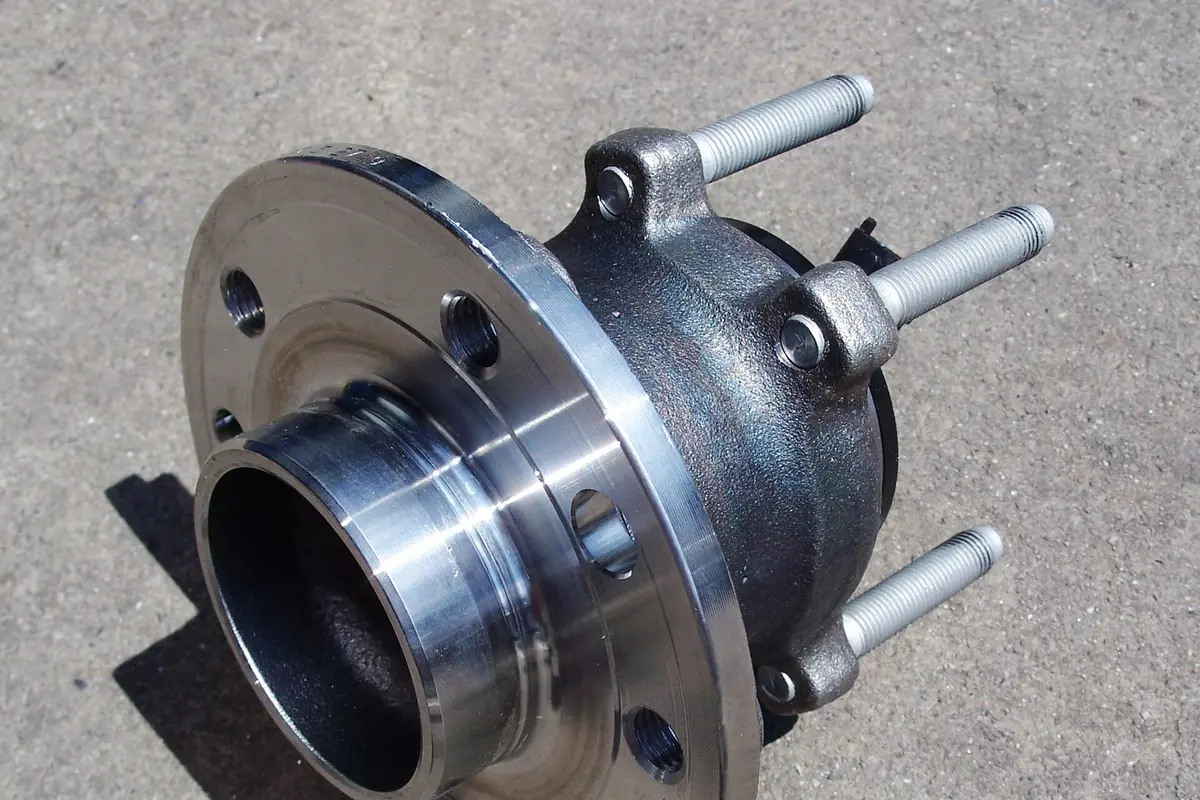
Most late-model Dodge, Chrysler and Ram vehicles use a bolt-on hub and bearing assembly. The bearing, hub and often the ABS sensor tone ring come as one unit, which makes replacement much easier. Some applications use a bearing that’s pressed into the knuckle and needs a press.
When ordering, the details matter:
- Front or rear, and left or right where they differ
- 2WD vs 4x4/AWD. AWD and 4x4 hubs have a splined center for the axle shaft.
- Brake package. Bigger SRT brakes can change the hub or knuckle.
- ABS sensor style (integrated or separate)
Our wheel bearing and hub listings show the exact Mopar numbers and fitment.
How urgent is it?
A humming bearing won’t fail tomorrow, but it won’t get better either. A bearing with play or grinding should be replaced right away: in extreme cases a failed bearing can let the wheel separate. On AWD and 4x4 vehicles, a failing bearing can also damage the ABS sensor and trigger traction-control warnings.
Replace in pairs?
Not necessarily. Bearings fail individually. But if the vehicle has high mileage and the other side is original, many owners replace both at once to save a second labor charge.
Other noises over bumps? See our front-end clunk guide. Clicking only when turning? That’s usually a CV axle.